Showing posts with label whole grains. Show all posts

Friday, August 9, 2013

Wheat Berry Bread

Whole grains are good, right? Therefore, whole grain flour is good, right? Well, according to some sources, it depends.

First of all, in case you haven't met, let me introduce you to the Glycemic Index or GI. I won't go into a lot of detail, but, according to Wikipedia, "the glycemic index ... provides a measure of how quickly blood sugar levels ... rise after eating a particular food. ... A lower glycemic index suggests slower rates of digestion and absorption of the foods' carbohydrates ... . A lower glycemic response usually equates to a lower insulin demand."

The assertion some people make is that the less processed a grain is, the lower the glycemic index. That definitely makes sense if you are comparing, say, white flour to whole wheat flour. But what about whole wheat berries compared to whole wheat flour? One is the powdered version of the other, but, like a puzzle, all of the pieces are still there.

Here's what Andrew Weil, M.D. says:

"Grains in their natural form have a low glycemic index, while processed carbohydrates, including those made with flour or puffed grains, have a high GI. The reason is that it takes longer for digestive enzymes to reach the starch inside whole grains or grains cracked into large pieces, slowing down the conversion of starch to sugar.

"You can be pretty sure you're eating a natural grain with a low GI ranking if you have to chew it or can see grains or pieces of grains in food products. The more your jaw has to work, the better. But when grains are pulverized into flour, whether whole or not, their surface area expands dramatically, providing a huge, starchy surface area on which the enzymes can work. Consequently, the conversion to sugar happens very quickly."

I couldn't find any studies to confirm this. The one study I did find seems to refute it. Its conclusion: "The particle size of whole grain wheat flour did not substantially affect glycemic responses."

According to Livestrong, "Wheat berries have a GI value of approximately 46 [in the low range], according to the Glycemic Index Foundation's GI database."

I could not find a specific GI value for whole wheat flour.

What I did find over and over was more-generalized advice, such as this from Maria Collavo-Clavell, M.D., endocrinologist with the Mayo Clinic:

"Basic principles of the glycemic index diet may help you better manage and control your blood sugar:
  • Choose high-fiber foods, such as whole grains, legumes, fruits and vegetables.
  • Choose fresh or raw foods over canned or processed foods."
My real-life experience is that it is difficult to find whole grain products, period, and to be sure of what you are getting. Which is one reason why I bother buying grains and using them for cooking and baking, most often grinding the grain into flour first.

Having said all that, I decided to bake Wheat Berry Bread. It is my good old Whole Wheat Bread with wheat berries added.

I cooked the wheat berries in my rice cooker: 2 C wheat berries to 6 C water. I think if you just want to eat the wheat berries, as in a salad, you would use less water, about 1 C wheat berries to 2 1/2 C water. I wanted them to be quite soft, so I used the greater amount of water. I also soaked them over night first.


Here's a closer view of the cooked wheat berries:


I added 3 C of cooked wheat berries to my bread dough as I mixed it. The wheat berries add chewiness and a nutty kind of flavor. You can see them in the bread!


After it cooled, I tried a slice ... and another ... and another. Definitely a keeper! I used it to make the sandwich I ate for supper tonight. That's 1 clove of chopped garlic on a slice of bread, a thin layer of Jarlsberg cheese, a layer of cooked broccoli, to be followed by another thin layer of cheese, and topped with another slice of bread.


And then toasted.


Simple and delicious and nutritious.

Sunday, January 20, 2013

Blueberry Muffins--Updated

I volunteered to bake a dozen blueberry muffins for an upcoming meeting.

Since I don't have a blueberry muffin recipe that I'm very enthusiastic about, I thought I would look around for one. I bought lemons when I went shopping because I definitely wanted to find a recipe that included lemon. I was also hoping for a whole-grain recipe.

I got lucky! The first place I looked, I found what turned out to be a great recipe. Thank you, King Arthur Flour recipes. Here is the recipe I found.

My tweaks:
  • I used flour that I ground from hard white wheat.
  • You'll notice that this recipe does not have any lemon in it. Otherwise, it looked so good that I checked the reviews. Some people had used lemon zest and reduced or left out the almond extract. So I left out the almond extract and added the zest of one lemon.
  • I used frozen blueberries for two reasons. For one thing, I already had some. Also, they are the small kind, from Maine, so you end up with the blueberry-goodness distributed more evenly throughout each muffin. The only bad part is that frozen blueberries tend to leave blue streaks in the muffins.
  • Another day I may write about the issues related to buying fresh blueberries in the middle of winter in a northern climate.
  • I didn't put a topping on because I didn't want to add any sugar. I think these muffins are already plenty sweet. They are muffins, not cupcakes, after all. In particular, I didn't want to use their suggested cinnamon-sugar topping because I don't think lemon and cinnamon mix very well. Another time I would like to try sprinkling some chopped or slivered almonds on top, but I didn't have any today. (I only buy almonds if I plan to use them for something specific because I love them way. too. much!)
  • I followed their directions for mixing the ingredients together. But next time I think I will add the wet ingredients to the creamed mixture, and then add the dry ingredients, followed by stirring in the blueberries. Their order seemed counterintuitive to me, since you want to mix the flour as little as possible. I'll update this if I find I'm wrong. Update: My way of mixing--dry ingredients after wet ingredients--was easier and worked beautifully.


The muffins smelled divine while they were baking.


The texture was very delicate. The taste was heavenly. No butter needed.

These muffins combine great taste and texture with 100% fresh whole-grain goodness.


Tuesday, January 15, 2013

Whole Wheat Maple Oatmeal Bread

This is good-tasting bread! The maple and the oats are prominent and yet complemented by the whole wheat.

I hope other people like this bread, because I want to keep making it. It gives me satisfaction to bake bread and rolls for people. It gives me great satisfaction to bake whole-grain bread and rolls for people!


This is the same as the Maple Oatmeal Bread. Except the flour is all whole wheat, freshly-ground, of course. A quarter of the flour is from soft white wheat. The rest of the flour is from hard white wheat.


Happy Oatmeal Month!


Friday, December 28, 2012

The Quest: Whole-Grain Cracked Wheat Bread

Cracked Wheat Bread--the favorite bread of many.

It is good bread: soft and springy with the chewy nuttiness of the cracked wheat; salty, and sweet with molasses.

It contains whole grain: freshly-cracked wheat berries.

But the flour is white flour: high quality flour--King Arthur bread flour--unbleached and unbromated. But lacking the nutritious bran and wheat germ of whole-grain flour.

Could I use whole-grain flour and maintain the distinctive taste and texture?

Today I am using flour freshly-ground from hard white wheat. This flour is milder than "regular" red wheat flour.


It is good bread: soft and springy with the chewy nuttiness of the cracked wheat; salty, and sweet with molasses.

The whole-grain flour adds some welcome complexity to the flavor. And the nutrition of whole grain.

I prefer this version of cracked wheat bread.

What about you?

Aunt Betty's Cracked Wheat Bread

Pour 4 C boiling water over 2 C (8.5 oz.) cracked wheat and stir. Let stand until most of the water is soaked up, but not dry.

Add:
C molasses
½ C plus 2 Tbsp. canola oil

Stir together and add, mixing with the dough hook of an electric mixer if you have it:
1 lb. flour (about 3½-4 C)--white bread flour or hard white whole-wheat flour
½ C sugar
2 Tbsp. yeast
1 C instant powdered milk
2 Tbsp. salt

Add and mix:
2 eggs
1¼ lbs. flour (about 4-4½ C)--white bread flour or hard white whole-wheat flour

Pour the dough onto a floured counter and knead it, adding more flour as needed, 1-2 C, until dough is smooth and elastic.

Place dough in an oiled bowl; cover with waxed paper. Let rise once. Measure and shape into 4 or 5 loaves. Let rise and bake at 350°F for about 40 minutes.

Saturday, December 22, 2012

Ginger Snaps

After making gingerbread houses and then gingerbread cake, it seemed only right to bake one of my favorite cookies: Ginger Snaps.

I found this recipe many years ago in my Joy of Cooking. My college roommate and friend, Lani King, gave that cookbook to me for my birthday in 1974. That cookbook has been one of a handful that I have kept at hand through the years. 15 years ago my family gave me the updated edition of Joy of Cooking. But I just never felt comfortable with it. For interest's sake, I pulled it out to see if it had my beloved ginger snap recipe in it. It was definitely based on the recipe from the earlier edition, but the differences were significant: the addition of baking powder, less baking soda, more ginger, more cinnamon, the addition of salt, double the amount of butter, less sugar, lemon juice in place of vinegar, and the addition of lemon or orange zest. What remained the same: flour, cloves, eggs, and molasses. I'll give it a try sometime, but for the moment, I'm going with my tried and true recipe.

I made the dough three days ago and baked some of the cookies then. So today I pulled the rest of the dough out of the refrigerator.


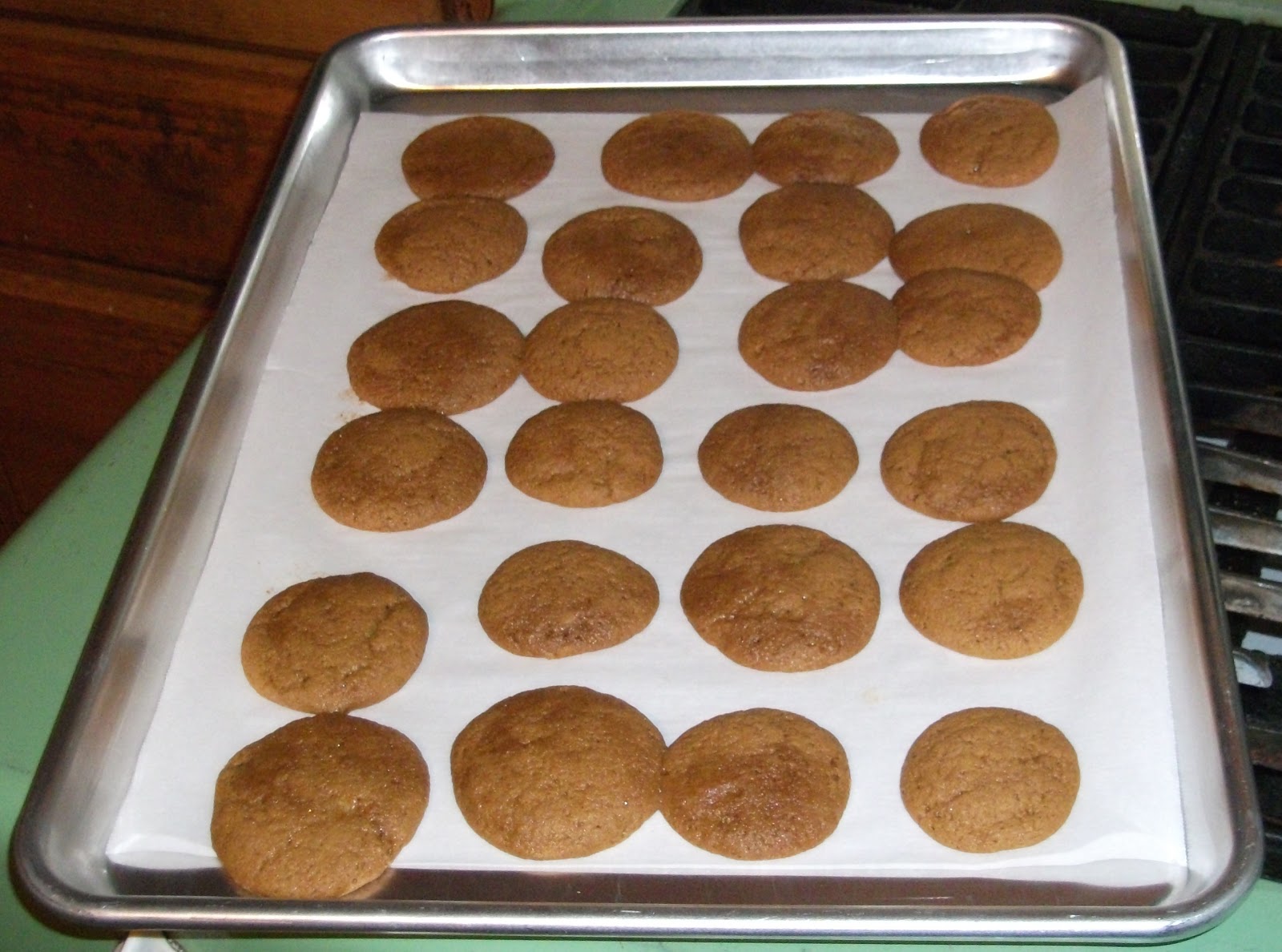
I used a spoon to dig out chunks of dough, which I rolled into balls. I set the balls onto a baking sheet. I used parchment paper to prevent sticking.


I baked them at 350 degrees for about 12 minutes.


Fresh out of the oven, they are a little puffy and very soft. You will see signs of the characteristic crinkling. Wait a couple of minutes for them to firm up before transferring them to cooling racks.


When they are cool, they are crinkly, and firm but chewy.

Several years ago, before I discovered white wheat, I tried making these using red whole wheat flour. I didn't like the flavor the flour added, so I continued to make them using all-purpose flour. Having recently used flour milled from soft white wheat successfully in other cookie, brownie, and cake recipes, I used some in making these cookies this time. Because I was giving away most of the cookies, I conservatively only replaced 1/4th of the all-purpose flour with the whole wheat flour. They are delicious, and, if anything, I think the texture is improved.

By the way, I don't pretend to think that a little whole wheat flour suddenly makes cookies nutritious. Cookies, by their nature, should always be eaten sparingly. However, any time I can replace refined grains with whole grains, I consider it a benefit.


Ginger Snaps

Cream together:
¾ C butter
2 C sugar

Stir in:
2 eggs
½ C molasses
2 tsp. vinegar

Stir together and add:
3¾ C all-purpose flour (or replace at least 1 C with soft white whole-wheat flour)
1½ tsp. baking soda
3 tsp. ginger
½ tsp. cinnamon
¼ tsp. cloves

Mix ingredients until well-blended. Form dough into small balls. Bake at 350°F on baking sheet lined with parchment paper (or greased), for about 10-15 minutes. Let cookies set for a couple of minutes before transferring to cooling rack.

Yields about 7 dozen cookies.


Thursday, December 13, 2012

Some Disturbing Nutritional News

Look at the two graphs on Marion Nestle's blog post titled "We eat what we buy. Both need improvement, says USDA." Focusing on grains, for example, we all know we're supposed to eat whole grains. It doesn't need to be 100%, but these graphs show that we, as a society, are way off the mark.

Here are two quotes from the abstract of the study cited by Dr. Nestle:

Overall, consumers purchase too few fruits, vegetables, and whole grains and too many refined grains, fats, and sugars/sweets.

Differences across income levels and across race are small,with all subgroups falling well short of the recommendations in the Dietary Guidelines.

And from "Discussion and Conclusions," page 15:

Virtually without exception among food categories, consumers allocate too much of their food budgets to less healthful options and too little to healthful options. We find that the average household falls far short in fruit and vegetable consumption and spends too much on sugars and refined grains. The correlation between income and purchase healthfulness warrants further research on both the food environment and consumer perceptions, particularly since healthy food options are typically not more expensive (Carlson and Frazao, 2012).

If you do better than this, keep up the good work.

If this describes you, consider making a small change for the better!